We are looking for an independent senior editor
Apply Now





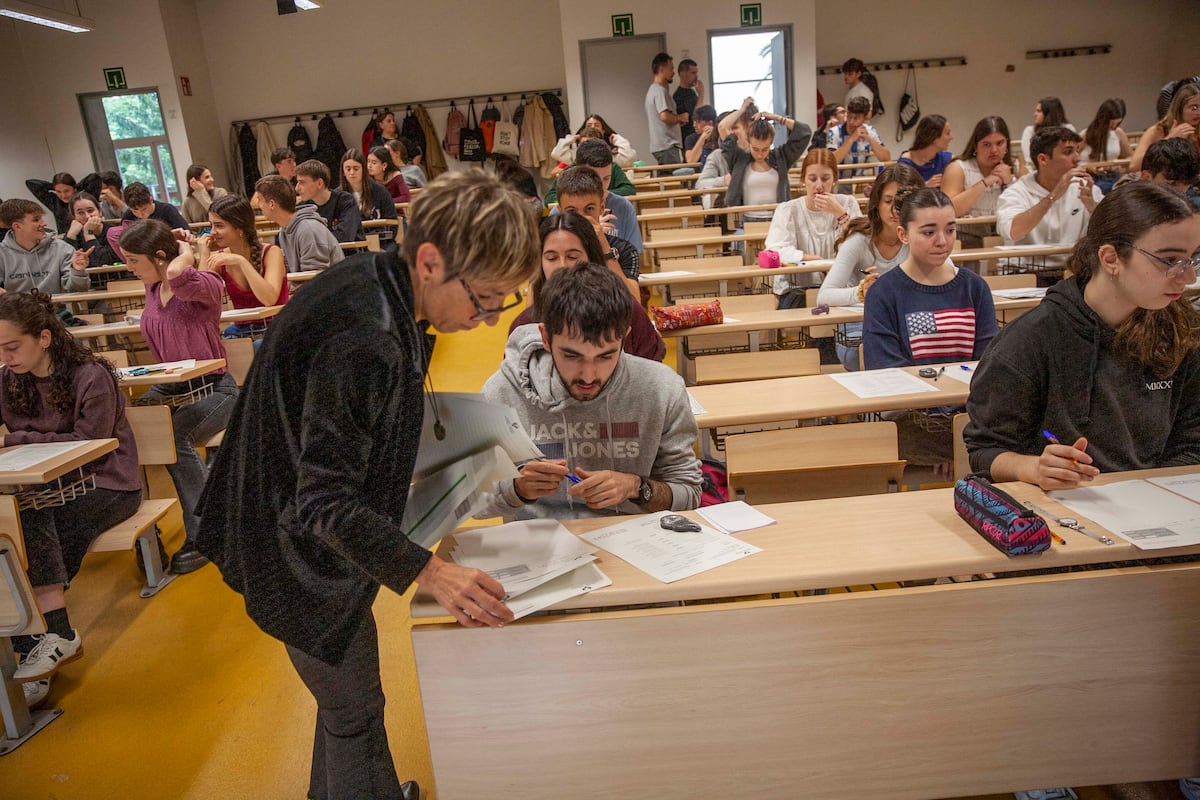
A young man dressed casually heads towards room 101 in the southern wing of the Tarongers campus at the University of Valencia for the first exam of the Selectividad. "No, I'm not nervous. But I have to go in now," he remarks briefly. Nearby, a teenager kisses her bracelet and bites her nails anxiously while listening to the instructions for the Spanish Language and Literature test. This exam marks the introduction of the new University Entrance Test in fifteen autonomous communities, reputed to be the most challenging in recent years.
In the hallway, three high school teachers who have accompanied their students confirm this impression. Is this year's exam more complex? "There is less choice," one teacher responds. "They have doubled the syllabus for the History of Spain exam," another adds. "Grades are going to drop because there are fewer options," the third teacher asserts, "and sooner or later, they had to do it because it had reached a point where it didn't make sense. I, for example, wouldn't be able to study Physics now, and back then, I got in without issue."
The Selectividad has begun across Spain, except in the Canary Islands and Catalonia, where it will start later. An estimated 300,000 students are expected to take the University Entrance Test (PAU), which will last three to four days, with up to four exams during the first two days, each lasting 90 minutes.
Last-minute review sessions started at 7:30 AM at the Complutense University of Madrid, with groups of students flipping through their notes. Others sought solitude, resting on benches or under trees, headphones on, waiting for the evaluation to start. Many looked frightened. Jaime Junco Díaz studies with a friend under chestnut trees. "I wasn't nervous before, but today I am," he admits. Junco Díaz aims to study Physiotherapy and faces exams in Spanish Language and Philosophy. "These don't scare me as much; it's all about studying the material. I might be more worried about Chemistry," he adds.
This year's exam format shift, including 25% competency-based questions, is seen positively by students. "Now, effort is rewarded more, and you arrive at university better prepared," one student argues. "Previously, you could study only 40% of the syllabus and still score well."
Early in the morning, at the entrance of the Faculty of Chemical Sciences, the Vice-Rector of Students at Complutense, Rosa de la Fuente, acknowledges students' concerns over the model change but assures them that they won't feel the same way after the exam. "It hasn't changed much; we've just reduced the number of content reproduction questions," she explains. Nearby, students gather to enter the classrooms and begin the exam.
While nine out of ten students pass the PAU, those aiming for the most sought-after degrees find scores soaring above 12 out of 14, the highest possible when adding the optional phase to the general phase.
As students head to Complutense, where 12,588 young people are expected to take the PAU, the Moncloa metro station in Madrid becomes a scene of nervous shouts and tightly packed folders filled with notes. Inside the train, a girl sighs while reading a handcrafted graph on modern Spanish literature. Her father, standing across from her, reassures her that everything will be perfect. The train echoes with anxious cries: "Can't believe today is the day"; "I won't discuss how the exam went later; eat, and keep studying"; "last night with María, we couldn't get anything right, we made up names"; "it was so hard to sleep last night!"
We are looking for an independent senior editor

LEAVE A COMMENT