We are looking for an independent senior editor
Apply Now





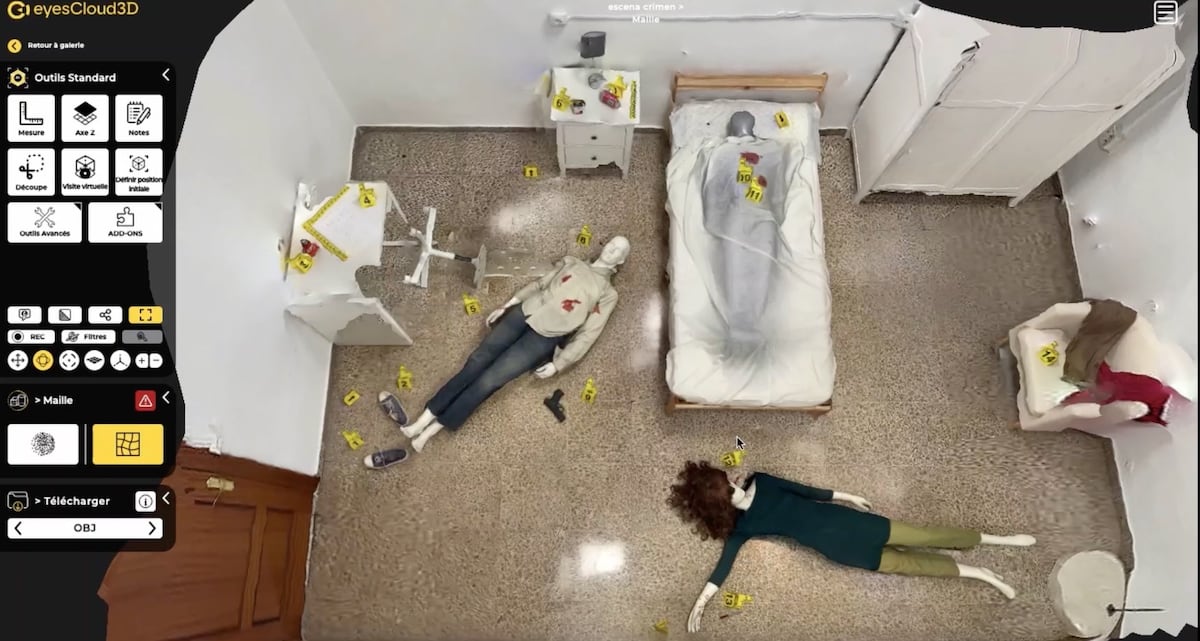
The intricate details of a crime scene demand meticulous scrutiny. How deep is that footprint? What's the distance between the hand and the knife? Which way does the blood spatter flow? Every component is crucial for law enforcement specialists who know inspections can span hours or even days. Emerging from Badajoz, a visionary company has crafted a 3D scene generation platform, developed through years of collaboration with police officers. This platform enables the reconstruction of investigation essentials using just a mobile recording, effortlessly calculating measurements, directions, distances, and marks through simple commands.
Known as eyesCloud3d, this company was established in 2015 in Extremadura by a group of topographers—scientists dedicated to studying the Earth's surface—aiming to create 3D models for their field. Miguel González joined two years later, revolutionizing the platform's direction. "We attended several security expos, where we engaged with various police officers who shared insights on their operations and needs," González recalls. Thus, the transition from topography to law enforcement began.
Their first substantial collaboration emerged from these expos with the Ertzaintza, the Basque Autonomous Police, specifically with traffic accident investigation units—a relationship that continues today. "When an accident occurs and specialized investigators arrive, hours might have passed. Within this time, alterations can occur. Officers manage traffic, medics assist victims, and firefighters rescue the trapped. With our tool, the first responder can record a video with a mobile phone, which is digitized to generate a 3D scene in about 20 minutes. Specialized investigators have a detailed overview before even leaving the office," explains González. Over time, many other local and autonomous police forces, including Madrid and Navarra, have adopted this system.
González concedes that his knowledge of police investigations has grown tremendously over the years. "I never imagined I would understand concepts like deformation energy," he jokes, referencing the force required to cause vehicular damage in traffic accidents. The key advantage eyesCloud3d boasts is its user-friendliness—no extensive programming or 3D expertise is needed. "We don't replace forensic work, which investigators must still perform, but anyone can record the footage, and learning to use the platform is straightforward," assures González. This technology allows for the integration of variables such as humidity, temperature, and lighting conditions at the time of an accident, thanks to data cross-referencing with weather apps.
One of the recurring requests from law enforcement officers to eyesCloud3d's technicians was the need for a clear and visual way to present investigation results in court. Officers explained that due to the complexity of their calculations and measurements, conveying conclusions to a judge or prosecutor was sometimes challenging. Numerous cases have already seen police rely on this platform's visualizations in trials.
Following traffic units, the company has advanced to collaborate with the National Police on a pilot project using their platform for photographing and documenting detainees. Although not yet implemented, this two-year project aims to employ the tool for biometric data recording, which currently involves fingerprinting and taking three photographs for databases.
The police already utilize artificial intelligence for suspect identification from surveillance footage. The biometric data that eyesCloud3d's tool could provide extends beyond facial features, capturing unique traits like hand movements, walking style, or even breathing patterns.
The potential within criminal investigation is boundless. This tool could measure and visually depict bullet trajectories at crime scenes, footprint depths, and blood spatter directions. "The program calculates the splatter trajectory, pinpointing the impact's origin where an ellipse forms," González illustrates.
Founded in Extremadura, eyesCloud3d plans to remain there for the foreseeable future. The company employs around fifty professionals from over ten nationalities, including Cubans, Spaniards, Russians, Peruvians, Colombians, and Uruguayans. Their team consists of computer engineers, mathematicians, physicists, and business graduates. They have initiated international expansion, particularly with Latin American police forces. For instance, they collaborated on a 3D crime scene reconstruction for an Ecuadorian prosecutor. The next goal is to enter the United States market. "There, the security sector is formidable," González notes.
We are looking for an independent senior editor

LEAVE A COMMENT