We are looking for an independent senior editor
Apply Now





On June 1, Mexico is set to embark on a historic journey as citizens head to the polls to elect judges, magistrates, and ministers for the first time. This groundbreaking election marks a pivotal moment in the controversial judicial reform initiated by President Andrés Manuel López Obrador, which was approved just weeks before the end of his term in September 2024. At the heart of this reform lies the transformation of the judiciary through public elections, a move that has sparked both anticipation and skepticism in the political landscape. The ruling party, Morena, views this as a critical opportunity to reshape the judiciary amid a general lack of public awareness about the candidates and their roles. Meanwhile, opposition parties are advocating for abstention, aiming to challenge the legitimacy of Morena's electoral process through low turnout.
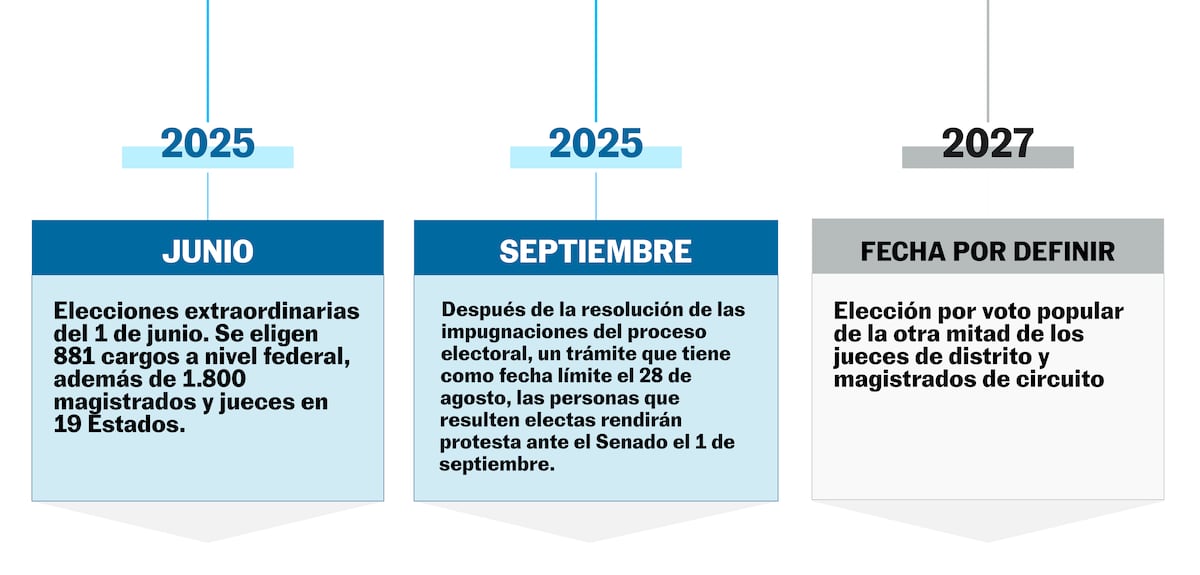
The judicial elections are structured in two phases, with the first phase on June 1, 2025, determining 881 judicial positions, including Supreme Court ministers, magistrates for the new Judicial Discipline Tribunal, the new Administration Body, and half of the district judges and circuit magistrates. A complementary electoral process will follow in 2027 to fill the remaining positions through public vote.
The vote counting process will commence at 6:00 PM on June 1, with the closure of polling stations. Over the next ten days, the National Electoral Institute (INE) will oversee the final count through district computations. The cumulative results will be announced at the General Council of the INE on June 15, 2025, two weeks post-election.
Nearly three months after the elections, both the Supreme Court and the Electoral Tribunal of the Federal Judiciary (TEPJF) are expected to resolve any election-related disputes by August 28, 2025. Newly elected officials will assume office on September 1, 2025, following a formal swearing-in before the Senate. At this juncture, new provisions for the Supreme Court will take effect, reducing the number of ministers from 11 to nine. The presidency of the Court will rotate every two years based on the number of votes each candidate receives, with the presidency awarded to the candidate with the highest vote count, according to the law.
Ministers elected in the special 2025 election will serve terms of eight and 11 years, depending on the number of votes they receive. The most voted ministers will remain in office until 2033, while others will serve until 2036. Notably, ministers who are not reelected on June 1, 2025, will not be eligible for the lifetime pension, which includes holiday bonuses, life insurance, vacation pay, and risk bonuses.
As for judges and magistrates, the judicial reform establishes a nine-year term with the possibility of consecutive reelection.
This judicial reform, spearheaded by López Obrador, was ratified by the Senate in early September 2024, just three weeks before the conclusion of his presidency. Despite its smooth passage through the House of Representatives, where Morena and its allies had a qualified majority, the reform faced considerable opposition in the Senate, where the ruling party needed just one more vote for a majority. Tensions escalated as opposition members alleged threats, blackmail, and even detentions by the ruling party, part of a pressure campaign to secure the decisive vote for the reform's approval.
We are looking for an independent senior editor

LEAVE A COMMENT