We are looking for an independent senior editor
Apply Now





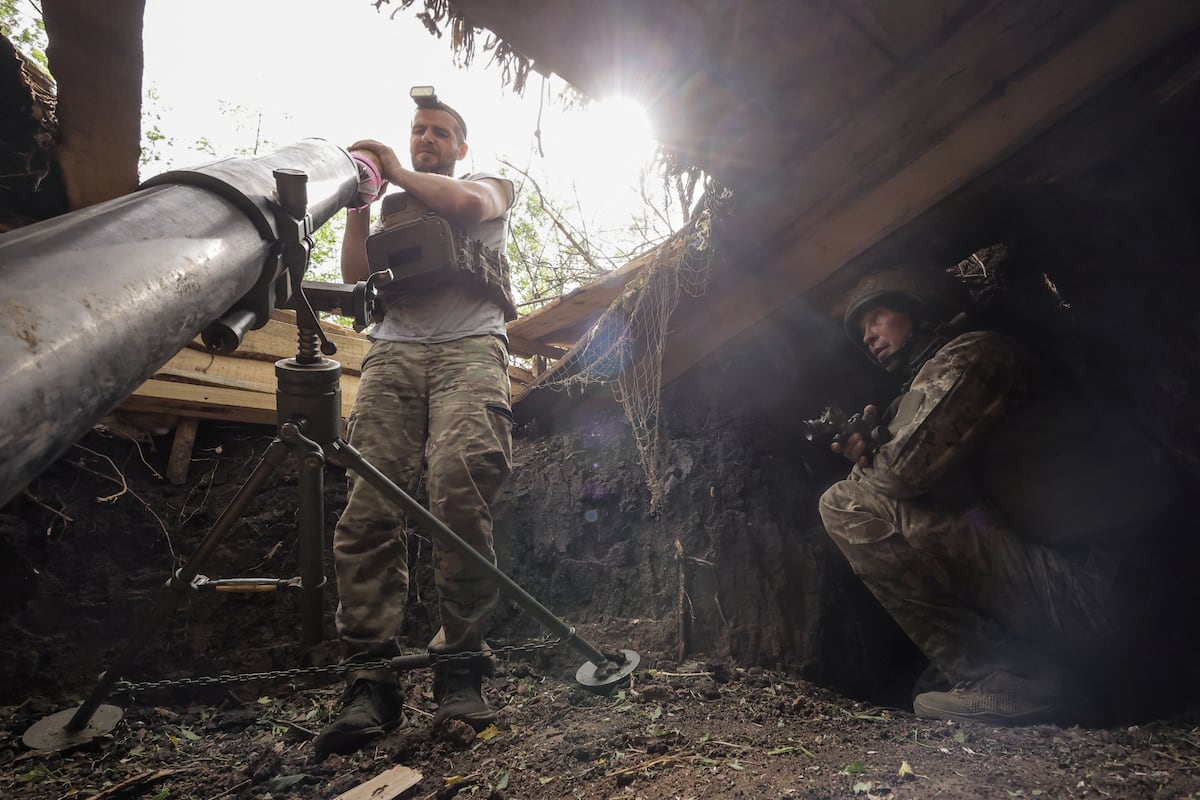
Analysts from Ukraine and the West, along with President Volodymyr Zelensky, have confirmed that Russia is already mobilizing forces for a large-scale summer offensive. On May 27th, Zelensky outlined Russian troops' four-pronged strategy: advance in Sumi, besiege Kostiantinivka and Pokrovsk in Donetsk, and attempt to gain a foothold in Dnipró from the south, aligning with Kremlin's imperial ambitions.
Negotiations for a temporary ceasefire seem unlikely to succeed, with Russia demanding more territorial control. A second meeting between the parties is slated for Monday in Turkey, but Russia's demands, including Ukrainian withdrawal from partially occupied provinces Lugansk, Donetsk, Kherson, and Zaporizhzhia, suggest President Vladimir Putin is not keen on halting hostilities. This perspective is shared by Kyiv's allies, the European Commission, and Zelensky himself.
Kremlin's unwillingness to ease demands for a truce persists, with independent Russian media like Mediazona reporting at least 110,000 Russian soldier fatalities. Ukrainian casualties exceed 75,000, based on social media reports, public records, and obituaries. Official figures are unavailable, and the true death toll likely surpasses these numbers, with tens of thousands missing. The United Nations estimates nearly 13,000 civilian deaths over the three-year conflict.
Despite Kremlin's claims of readiness for peace, battlefield developments tell a different tale, according to Mikola Bielieskov from the Atlantic Council. This expert from Ukraine's National Institute for Strategic Studies foresees the upcoming Russian summer offensive as potentially the deadliest yet.
Indications show the offensive has commenced despite ongoing daily rains in Ukraine, complicating armored infantry maneuvers essential for assaults. Former Zelensky spokesperson Iiulia Mendel announced on Wednesday that "the Russian summer offensive is underway," noting 100 square kilometers captured within a week—the largest advance since winter. May saw a 41% increase in invasion assaults, according to Mendel.
Bielieskov outlines Russia's continued focus on high-casualty assaults, acknowledging Kremlin troops' growing use of motorcycles and other small, fast vehicles like quads for penetration. This strategy is supported by aerial bombing, drones, and artillery surpassing Ukrainian capabilities.
Ukraine's key advantage, Bielieskov asserts, is the "drone wall," saturating the front with observation and attack drones, complicating troop movements and minimizing attacker advances.
Jack Watling from the UK's Royal United Services Institute (RUSI) argues in a May report that the Russian summer campaign will differ from traditional offensives, lacking the capability for rapid mechanized unit maneuvers. Watling anticipates a gentle start with escalating assaults, noting signs of commencement.
Watling highlights intensified long-range bombardments against distant cities, aiming to demoralize civilians and disrupt supply logistics for frontline regiments.
Contrary to Watling's remarks on a limited offensive, Moscow's recent acquisition of 100 square kilometers marks a significant escalation over the past six months. The territory spans Ukraine's Sumi-Russia border, north of Kharkiv, and Kostiantinivka's vicinity. Zelensky confirmed Russian efforts to establish a "protection zone" around Sumi, 10 kilometers wide, to prevent Ukrainian incursions into Russia's Kursk province, targeted in summer 2014 by Ukrainian forces. Russian-controlled Ukrainian territory remains marginal.
Zelensky and military experts assert these border "protection zones" aim to divert Ukrainian troops from Kremlin-coveted enclaves, specifically Donetsk.
Finland's Black Bird war analysis group estimates Russia's progress in Kostiantinivka and Pokrovsk (Donetsk) has been "relatively swift," posing serious challenges for Ukrainian defenses. The main challenge is maintaining logistics networks to these cities. Since 2024, Russians have slowly advanced in both municipalities to isolate them from three sides, making access roads vulnerable to Russian drones.
Capturing Kostiantinivka hinges on fully occupying neighboring Chasiv Yar, a strategic elevated stronghold resisting Russian advances in Donetsk for over a year. Kremlin forces now control 80% of this battle-ravaged village.
Black Bird emphasizes Ukraine's need for more efficient ammunition use. A key issue for Kyiv is the Trump administration's reluctance to provide new military aid, with Biden's arsenal likely depleting by summer. However, Ukraine continues receiving US intelligence on missile launches and enemy base locations.
Another obstacle for Ukrainian forces is the soldier shortage, as recruitment difficulties become evident on the front, verified by numerous military units interviewed by EL PAÍS in the past year. Serhii, an officer from Ukraine's 3rd Assault Brigade, noted last week that troops endure up to 40 days on the front line without rotation, compared to rotations every four to seven days in 2022.
Black Bird forecasts "Russians will likely attack with full force during summer [starting June, when rains subside] through autumn, exerting pressure on Ukrainians across a wide frontline." The group also predicts battlefield events will influence peace negotiations, with Ukrainian authorities expecting no serious talks until after autumn, as stated by prominent Ukrainian political scientist and military figure Kirilo Sazonov on May 8th via public television TSN.
We are looking for an independent senior editor

LEAVE A COMMENT