We are looking for an independent senior editor
Apply Now





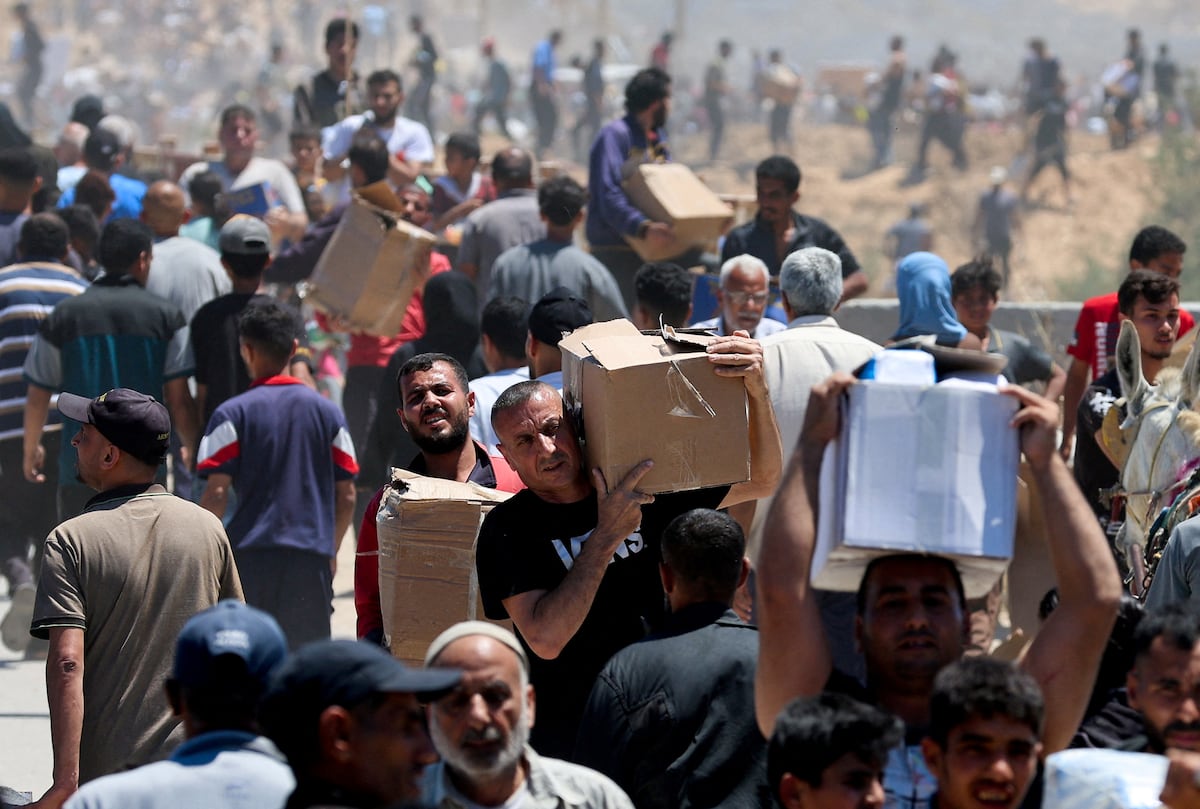
The trickle of humanitarian assistance into Gaza faces significant barriers, with the UN holding the administration of Benjamin Netanyahu accountable for the impediments. The Office for the Coordination of Humanitarian Affairs (OCHA) has accused Israeli authorities of intentional obstruction, suggesting a lack of willingness to facilitate efficient humanitarian responses. Jonathan Whittall, the agency's director in Palestine, has expressed concern over Israel's resistance.
On the same day, desperation driven by hunger led crowds to raid 86 trucks carrying aid within the enclave, as local sources claim most residents have yet to experience the benefits of a limited reopening of humanitarian flows. The persistence of Israeli airstrikes resulted in over 60 deaths on Saturday, while the prospect of a ceasefire remains uncertain. The Islamist militia Hamas has responded to a truce proposal from the White House, publicly accepted by Israel, by offering to release 10 living Israeli hostages and 18 deceased, while demanding guarantees for the end of hostilities and Israeli withdrawal from the Strip.
On May 18, Israel announced the lifting of the absolute blockade on Gaza, a decision encouraged by the United States after two and a half months of restricted aid. A private foundation, independent of the UN and supported by Israel and the US, has recently managed part of the limited assistance arriving in Gaza, though humanitarian voices criticize its failure to meet humanitarian standards. Despite these efforts, Gaza continues to suffer from malnutrition-related deaths, with the entire population at severe risk of food insecurity, according to recent OCHA warnings.
In a statement, the UN agency has held Israel responsible for many of the "obstacles" in aid distribution. It laments "delays" in receiving permits from Israeli authorities and criticizes the offering of "inappropriate routes" for transporting goods, which compromises the mission. Whittall has explained, "We face desperate crowds looting parts of our cargo," concluding, "Our work is obstructed."
On Friday night, Philippe Lazzarini, head of the UN agency for Palestinian refugees (UNRWA), echoed similar sentiments, stating, "The current massive hunger can be avoided. All it takes is political will."
Amid scarcity, desperation arises. Amjad Shawa, director of the network of Palestinian NGOs in Gaza, confirmed to this publication that hungry crowds raided 86 trucks on Saturday, mainly carrying flour. The assaults were launched by civilians and armed clans. Shawa commented, "I'm against these armed robberies; it's a crime," but added, "I can understand the desperation. People are starving; we see the pain in children's eyes due to malnutrition. Bringing some bread to their children saves lives."
Shawa estimates Gaza's needs at 600 trucks daily with food, medicine, and fuel, a sentiment shared by UN representatives. He recalls that this flow existed during the short truce that ended in March and before the conflict. The humanitarian director criticizes the aid entering Gaza since Israel's announcement for its resumption as "not even a drop in the ocean." Since the reopening of aid entry on May 19 until May 29, over 840 trucks were approved to access the enclave. However, according to Shawa's records, only 590 actually gained entry, with just 192 reaching distribution points and the Gazans.
The sound of warplanes is captured in Shawa's voice messages. The Israeli offensive has claimed at least 60 lives within 24 hours, according to Gaza's health authorities. As on previous days, at least two individuals perished while seeking food at one of the distribution points under the new mechanism supported by the US, which the humanitarian sector views as an extension of Israel's military operation.
Meanwhile, Hamas has refrained from outright rejecting the US-led truce plan accepted by Israel. The militia agrees to the release of hostages but has added crucial amendments to the proposal.
The current offer on the table is the latest version of a proposal by Steve Witkoff, special envoy of the White House to the Middle East, which includes Hamas releasing 10 living hostages and 18 deceased in two phases (59 remain in the Strip) in exchange for a 60-day ceasefire.
Unlike previous plans that displeased the Israeli government, this text does not provide guarantees for ending the war or for Israel's withdrawal from the enclave, which Hamas insists needs rectification. In its response, Hamas states that, from a "profound sense of responsibility towards the suffering" of the population, it seeks "permanent ceasefire, complete withdrawal [of Israeli forces] from the Strip, and ensuring humanitarian flow [to the enclave]."
The Palestinian demands represent a counterproposal on which the Israeli Prime Minister has commented Saturday night. Netanyahu has asserted that Hamas "maintains its rejection" and that Israel "will continue its actions in Gaza for hostages' return and Hamas's defeat."
Witkoff, acting as mediator, anticipated the Israelis and expressed on social media that Hamas's response is "unacceptable" and "only sets us back."
Successive negotiation rounds since late 2023, following Hamas's attack on Israel on October 7 and the Israeli offensive that ensued, have reached a deadlock. The Israeli government demands the exile and disarmament of the militia and even the departure of Palestinians from the enclave, while the fundamentalist group refuses to disarm unless credible pathways are established towards creating a Palestinian state.
We are looking for an independent senior editor

LEAVE A COMMENT