We are looking for an independent senior editor
Apply Now





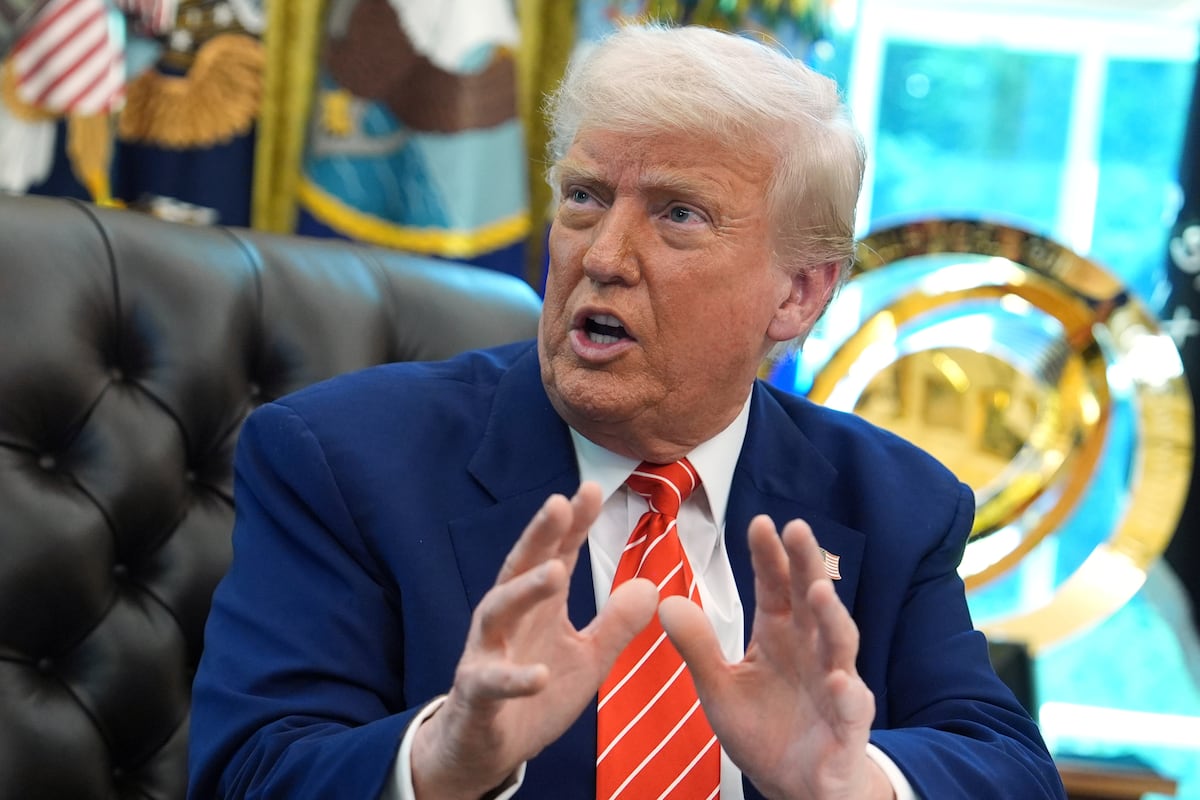
Most tariffs imposed by the U.S. President, Donald Trump, hang in the balance following a ruling from the International Trade Tribunal declaring them illegal. Trump was absent from public view all Thursday, only addressing the issue after the Federal Appeals Court in Washington delayed the enforcement of the ruling. On Friday, during an Oval Office meeting to bid farewell to his ally, Elon Musk—who opposes the tariffs—Trump articulated his trade philosophy: "Without tariffs, our nation would be in danger."
Trump has erected a tariff wall against the world, and on Friday, he showcased a CNBC video reporting that the trade deficit had nearly halved in April compared to March. However, he failed to mention that in the first quarter, particularly in March, the deficit shattered records due to accelerated imports to dodge tariffs. From January to April, the imbalance reached unprecedented levels, exceeding $550 billion, almost 50% higher than the same period in 2024.
"Tariffs are very important, which is why we are thrilled with the decision made yesterday to keep them, because without tariffs, our nation would be in danger," Trump emphasized. "We would be truly in danger. I believe I can say that with total certainty, Scott, Howard, so we're very glad about the decision made yesterday," he stated, addressing Treasury Secretary Scott Bessent and Commerce Secretary Howard Lutnick, who were in the background.
On Thursday, Trump launched an attack on the judges, questioning whether their decision was driven solely by "hatred" towards him. The ruling clarified that tariffs were illegal because the president had overstepped his powers, bypassing the Constitution and the law. Although the implementation of the ruling is suspended, the decision has not been overturned and has yet to be appealed.
Despite the significance he attaches to the matter, Trump hadn't learned the lesson and referred to the International Trade Tribunal's ruling as a provisional suspension on Friday, when it is a substantive ruling, but he still labeled it as "ridiculous."
"It would have meant the loss of presidential power. It would have meant the loss of everything the founders granted, it would have been something terrible and, most importantly, it would have left us in a vulnerable situation. Many countries impose tariffs on us and use them cruelly, really cruelly. And if we didn't have the power to impose tariffs on them, and immediately, not going to Congress and trying to get hundreds of people to agree, (...) there would be no country left. We have to act swiftly. We must be quick and agile," he argued. "If we don't have the power to do what they're doing to us, we will no longer be a great nation," he insisted.
Although Trump is confident that the Supreme Court, with a majority of six conservative judges versus three liberals, will rule in his favor, his team has started to look for a plan B to approve tariffs if it is confirmed that the emergency route he used is inappropriate. The judges' ruling reminded that the Trade Act of 1974 grants the president the ability to impose tariffs for a limited period of 150 days and with a ceiling of 15% in response to trade deficit imbalances.
This would allow the majority of current tariffs to be maintained while specific investigations are conducted country by country to impose tariffs in response to unfair trade practices, as another provision permits. This requires a lengthy and cumbersome process but has better legal foundations. It is the path Trump used during his first term to impose tariffs on China.
"There is no plan B. It's plan A. Plan A encompasses all strategic options," declared Peter Navarro, one of Trump's most hawkish trade advisors, implicitly admitting the search for alternatives.
Trump declared on Friday at the White House that China "has violated a large part" of the agreement reached between the two countries earlier this month in Switzerland to de-escalate the trade war. By doing so, he corrected himself, as hours earlier he had written on Truth, his social network, that China had "totally violated" said agreement, but continued without explaining how.
The deal was a way to dress up a full-scale correction by Trump, in which he lowered tariffs on Chinese products from 145% to 30% amid fears of steep price hikes and empty shelves in stores. Along with other retreats, it led to the popularity of the TACO strategy on Wall Street. The initials refer to "Trump Always Chickens Out," meaning "Trump always backs down," which involves investing with the premise that he ends up reversing his most radical measures and threats. Trump was enraged by such claims and now tries to present the agreement with China as a favor to Beijing.
The president does not specify in what way China is not complying with the agreement negotiated earlier this month in Switzerland. At that time, both countries merely stated in a joint declaration that they would reduce reciprocal tariffs and continue trade negotiations. Trump said that China had agreed "to fully open their market," but that was not reflected in the document in any way, so it seemed more like a lie from Trump to avoid admitting he had backed down without securing concessions.
This Thursday, Trump said he hopes to speak with the Chinese President, Xi Jinping, and resolve it. In reality, he has been saying this for months, and that conversation has not taken place.
We are looking for an independent senior editor

LEAVE A COMMENT