We are looking for an independent senior editor
Apply Now





Dmitri Shostakovich, a prolific and tireless composer, left behind an extensive body of work that spans 150 volumes in a new critical edition. Despite his vast output, the average music enthusiast is familiar with only a small fraction of his creations. Among his lesser-known masterpieces are the soundtracks for Hamlet and King Lear, directed by Grigori Kozintsev, who collaborated with Shostakovich from the age of twenty. These scores are part of the composer’s late period, during which he also scored music for 34 other films.
Shostakovich's chamber music is more accessible, and will be showcased in nearly its entirety by the end of the grand festival organized by the Gewandhaus. His symphonic and concertante works are also featured, along with a representative selection of his often-overlooked songs. These songs, composed to Russian or translated Russian poetry, include high-quality collections such as Shakespeare's Sonnet No. 66, translated by Boris Pasternak. The third stanza of this sonnet uncannily mirrors the reality of Stalinist Soviet Union: "and art imprisoned under authority, / and folly called wisdom, / and truth called foolishness, / and good led by a captain." Shostakovich's music brings these verses to life with bell-like clarity.
His symphonies and string quartets, the most recognized and disseminated of his works, exist in parallel without intersecting. Their creation periods differ slightly: 1925-1971 for symphonies and 1938-1974 for quartets, with minor but meaningful overlaps at both ends. In chamber music, no key is repeated, unlike his symphonies, where some share identical tonics. Whether Shostakovich planned to compose more symphonies after his 15th remains unknown; however, it is certain that, had he not succumbed to lung cancer in 1975, he would have continued to compose string quartets, perhaps reaching twenty-four, thus completing a perfect circle in all major and minor keys, much like his inspiration, Johann Sebastian Bach, in The Well-Tempered Clavier.
Shostakovich's thick glasses symbolically separated him from the world, suggesting that his quartets emerged from within, intended only for himself and his conscience. Conversely, several symphonies were products of his role as an official artist, documenting revolutionary achievements and events that were far removed from his personal existence. It was only when he renounced this – as in the Symphony No. 14, a harsh meditation on death to be performed at Leipzig’s closing concert – that he transformed the orchestra into a giant quartet. Similarly, he maintained his integrity even amid extramusical circumstances. In Quartet No. 8, dedicated "to the victims of fascism and war," the D-S-C-H motif (D-E flat-C-B), representing his name in German musical notation, recurs, echoing Bach's usage of his own name in compositions. This sincerity, essential to art, permeated his music.
In some symphonies, Shostakovich had to mask his true voice, but in his quartets, he remained authentic, drawing inspiration from Beethoven's quartets, his unequivocal model. Like Beethoven’s farewell through the Cavatina of Quartet Op. 130, Shostakovich entrusted his farewells to the string quartet. Here, more than in any other part of his catalog, he emerged as a spiritual heir to Beethoven, whose portrait adorned his Moscow studio.
The Gewandhaus wisely entrusted the complete cycle to the Franco-Belgian Cuarteto Danel, known for their near-apostolic mission to spread Shostakovich’s music, following in the footsteps of the Beethoven, Borodin, and Fitzwilliam quartets. Their performances in Leipzig have had a cathartic impact, with extended silences followed by growing enthusiasm. Their renditions, including the well-known Quartet No. 8 and the elusive Quartet No. 14, resonate deeply with attentive listeners.
Cuarteto Danel has performed the complete collection worldwide, often alongside Mieczysław Weinberg’s works, a friend of Shostakovich. Their interpretations are seemingly clinical, devoid of unnecessary dynamic excesses, with Marc Danel’s expressive contortions as the sole eccentricity. These movements, however, facilitate an inexhaustible technical and timbral repertoire. A passage from the final movement of Quartet No. 14, with rapid sequences of two, three, or four notes across instruments, exemplifies the homogeneity of sound, bow strokes, and dynamics they achieve. Their extraordinary vision of the complete picture benefits from their extensive experience presenting the entire collection. Shostakovich often wrote attacca indications between movements, suggesting each of the 15 quartets is indivisible, a unity that Cuarteto Danel uniquely imparts.
The song sessions on Monday and Tuesday afternoons were equally enlightening. While not comprehensive, they included all six programmed collections: ambitious From Jewish Folk Poetry; emotionally charged Six Poems of Marina Tsvetaeva; perfect and original Seven Romances on Poems by Aleksandr Blok; and terminal Suite on Verses of Michelangelo Buonarroti. These highlighted Shostakovich's biting wit in Satire Op. 109 and the youthful gem Romances on Japanese Poets’ Texts Op. 21. A fitting closing to such an ambitious festival would have been the brief gem Prologue to the Complete Collection of My Works, where Shostakovich mocks his official awards: “And here is the signature: Dmitri Shostakovich.”
During one of his late-life depressions, Shostakovich, following Britten’s example, set several of Michelangelo’s poems to music. Unlike Britten, who did so during the early days of his relationship with tenor Peter Pears, Shostakovich was drawn to the tragic and pessimistic side of the poems. The voice of the great bass Yevgeny Nesterenko, who premiered the work, was in his mind during composition. The titles “Death” and “Immortality” of the last two songs suggest a personal link with Michelangelo: geniuses die, but their works endure, achieving immortality. It’s no surprise that Shostakovich included romances by Mikhail Glinka and Songs and Dances of Death by Modest Mussorgsky at the premiere.
In Leipzig, the singers were chosen with great care: soprano Elena Stijina, mezzo Marina Prudenskaya, tenor Bogdan Volkov, and, replacing the announced Günther Groissböck, bass Alexander Roslavets. Pianist Elena Bashkirova, though more skilled as a chamber musician than a vocal accompanist, provided accompaniment. The standout was Ukrainian Volkov, memorable as Ferrando in Così fan tutte in Salzburg during the pandemic and as Prince Guidon in The Tale of Tsar Saltan at Teatro Real. He is poised to become a leading tenor in repertoires suited to his voice. Prudenskaya impressed with her authentic dark voice and profound expressiveness. Stijina, with her prodigious voice, excelled in Romances on Poems by Blok, a work Shostakovich could not premiere due to a heart attack, replaced by Weinberg alongside David Oistrakh, Mstislav Rostropovich, and Galina Vishnevskaya. The evocative pieces from Saint Petersburg and the final song, the only one featuring all four performers, resonated deeply with the audience. However, the Suite on Verses of Michelangelo lacked comparable intensity, with Roslavets delivering more of a sight-reading than a nuanced performance.
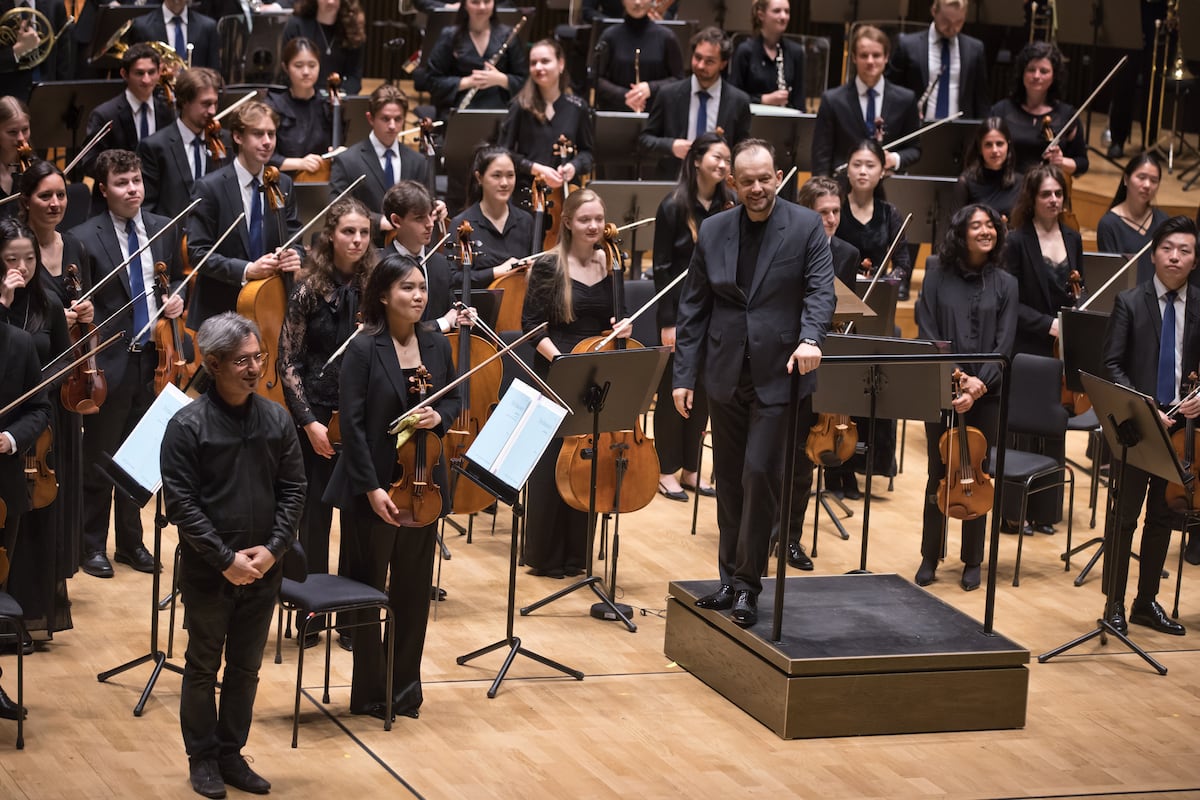
In the orchestral section, Wednesday afternoon featured the Violin Concerto No. 2, a highly lyrical piece effectively performed by Baiba Skride, and Symphony No. 13, based on Yevgeny Yevtushenko's poems. One of Shostakovich's most original works, it echoes Das Lied von der Erde, including a transcendent celesta finale, concluding a somber and painful composition. Here, Günter Groissböck sang, though not in peak vocal form, supported by the basses of three Leipzig choirs to infuse dark hues into a score where cellos and double basses have more prominence than violins, and the tuba plays a significant solo role. Andris Nelsons conducted with full engagement in the work's themes (injustice, death, oblivion), leading the Gewandhaus Orchestra, with Valencian Inmaculada Veses as oboe soloist, responsive to his increasingly economical yet effective and musical gestures. Aware of Shostakovich's major work, Nelsons fostered a prolonged silence at the end, essential for absorbing such an intense and emotionally prolonged onslaught.
We are looking for an independent senior editor

LEAVE A COMMENT