We are looking for an independent senior editor
Apply Now





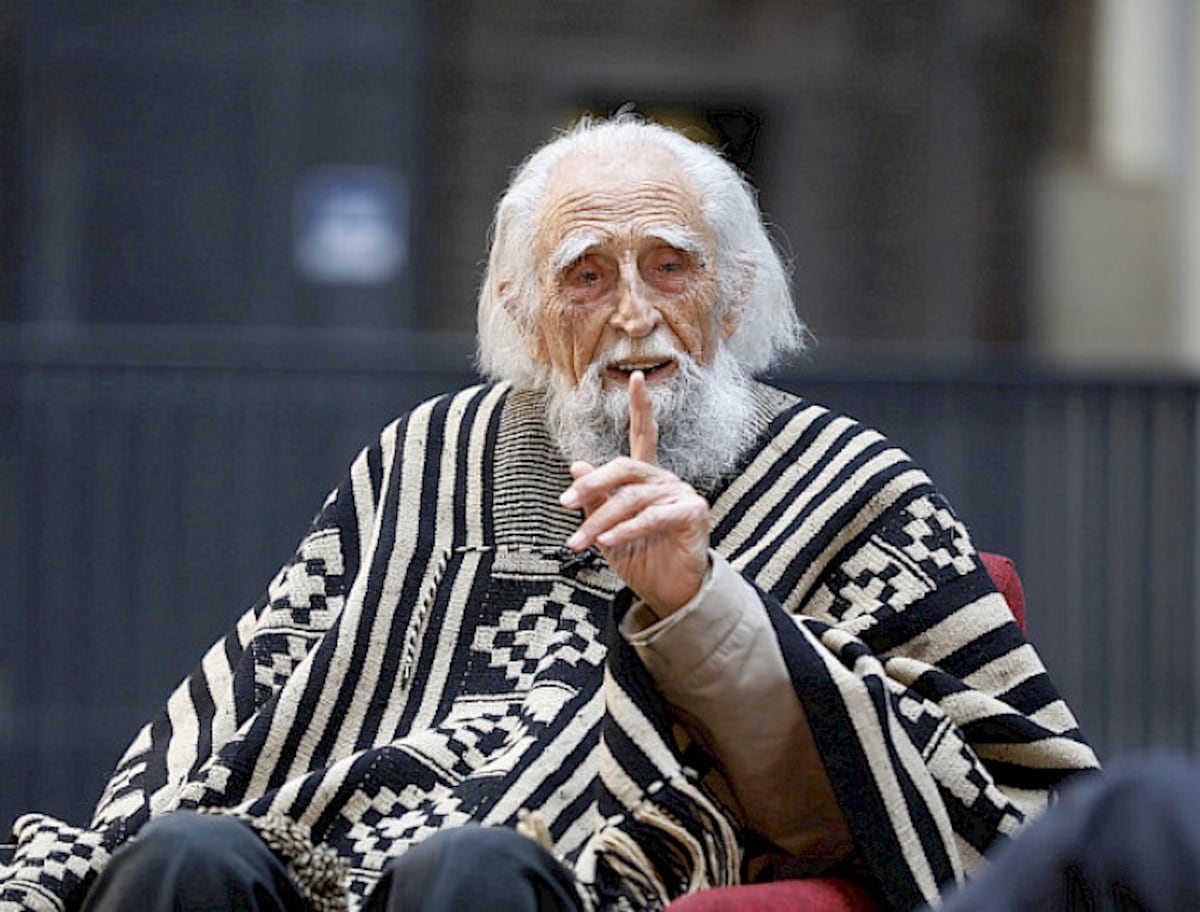
On the morning of Sunday the 25th, a message landed softly on my WhatsApp, so light it seemed to carry the whisper of the wind. It read, "Beloved, at dawn, birds and a curious dance of trees and leaves heralded the farewell of the great walker, the thin and gaunt knight with a long stride. Our beautiful sage, decipherer of enigmas, the kultrunes' song, friend of Violeta, of the ñañas and ñuques, unwavering in the revolution of stars and rhizomes." The messenger and author: actress Malucha Pinto.
With the speed of a whirlwind, the news spread: Luis Gastón Soublette, awarded the National Prize for Humanities and Social Sciences in 2023, had passed away at the age of 98. A musicologist, Christian philosopher, expert in Mapuche culture, professor at the Catholic University, an esteemed sage and mentor.
Tall, slender, with elongated bones, Soublette embodied a Chilean version of Quixote. Always seen in his signature Mapuche poncho, with a cane, his pace slow yet upright. His hair, beard, mustache, and thick eyebrows were all white, making him appear as if snow surrounded him. Gastón, the timeless figure of the poncho, the infinite man, faced numerous challenges: colon cancer, cataract surgery resulting in retinal detachment, severe bronchitis leaving one lung damaged. Despite never complaining, his body grew weary. Yet, he had no desire to leave, not just yet.
He was bid farewell at his home in Limache, where he had anchored for decades with his wife. Surrounded by trees, he nurtured his beloved garden, ate healthily, and consumed little alcohol. He favored carrot juice, excellent for soups and consommés, and meditated extensively. When visiting Santiago, he stayed with his only sister, Silvia, who passed away in 2020 on Gastón's birthday. They shared a close bond.
Gastón's departure was reportedly serene, in the company of loved ones. Under a clouded sky, the ceremony commenced around two in the afternoon at Valparaíso cemetery 1. Family, friends, former students, and strangers gathered to bid farewell. The assembled machis declared Gastón one of them, a lonko. Valparaíso's mayor, Camila Nieto, welcomed him to the city's hills and wished him a beautiful journey back to the source of universal love. Everything proceeded smoothly, largely due to Gastón himself, who meticulously organized his farewell, even choosing the biblical readings.
A forward-thinking individual, two years prior, Gastón tasked his personal assistant Javiera Blanco, communications director of Ediciones UC, with founding a namesake foundation. He left behind a handwritten note outlining ten objectives he envisioned.
As the author of numerous books and essays across diverse intellectual and academic subjects, Soublette favored the typewriter over modern technology, refraining from owning a cellphone or using email. He was a cornerstone of the Catholic University, teaching and researching for nearly seven decades in philosophy, aesthetics, music, and theology. As the director of the UC's Aesthetics Institute, he fiercely opposed its closure during the dictatorship.
Born in Antofagasta, he studied at Los Padres Franceses school in Viña del Mar. Initially set to become a lawyer, he pursued those studies at the University of Chile before abandoning them, later deeming them a waste of time. He also spent a year studying architecture at the Catholic University of Valparaíso, but it wasn't his calling. He ventured to France, studying musicology and composition at the Paris Conservatory, where he met his wife Bernadette Saint Luc, who passed away in 2019. Together, they had three children: Francisco, Isabel, and Violaine.
Charismatic, with insatiable curiosity, Soublette maintained close relationships with teachers and students, encouraging exploration and dialogue. In one of his last conversations, he shared that his happiest moments were during his teaching years. During the dictatorship, he was a staunch opponent of Pinochet, courageously defending students in strikes and protests, preventing their arrests multiple times. His classes were free, fostering personal discovery and deep reflection. Half were formal students from various disciplines, and the other half were frequent auditors. He opposed tests and grading students.
Attaining the National Prize for Humanities and Social Sciences was challenging; success came on the third attempt. After two failures, in June 2023, the honorable jury received a petition with 7,620 signatures advocating for Soublette's recognition. The jury acknowledged him as "a scholar of humanity, a humanist who exercises both the critical role of knowledge and the value of human wisdom in its relation to nature, a sage necessary for the times we live in."
His two great mentors were Violeta Parra, who entrusted him with preserving popular culture and traditional wisdom, and Lola Hoffman, who introduced him to oriental philosophy. He was a disciple of Mahatma Gandhi and Italian philosopher Giuseppe Lanza del Vasto, who connected him with India and pacifism. He delved into Chinese sages, writing several books on Tao, Lao Tzu's virtue, and the historical wisdom of the I Ching. Later, he applied his knowledge in collaboration with renowned national folklorists such as Violeta Parra, Margot Loyola, Gabriela Pizarro, and Héctor Pávez.
Identifying as a pacifist and a Christian, though not Catholic, he viewed Jesus Christ as the great popular sage, the foremost prophet. He believed in the kingdom of heaven and resurrection, expressing to those who would listen that Chile was "a country ruined in terms of human quality." His favorite phrase, a stark warning, was "The great will come!" It was only a matter of time, he asserted.
We are looking for an independent senior editor

LEAVE A COMMENT