We are looking for an independent senior editor
Apply Now





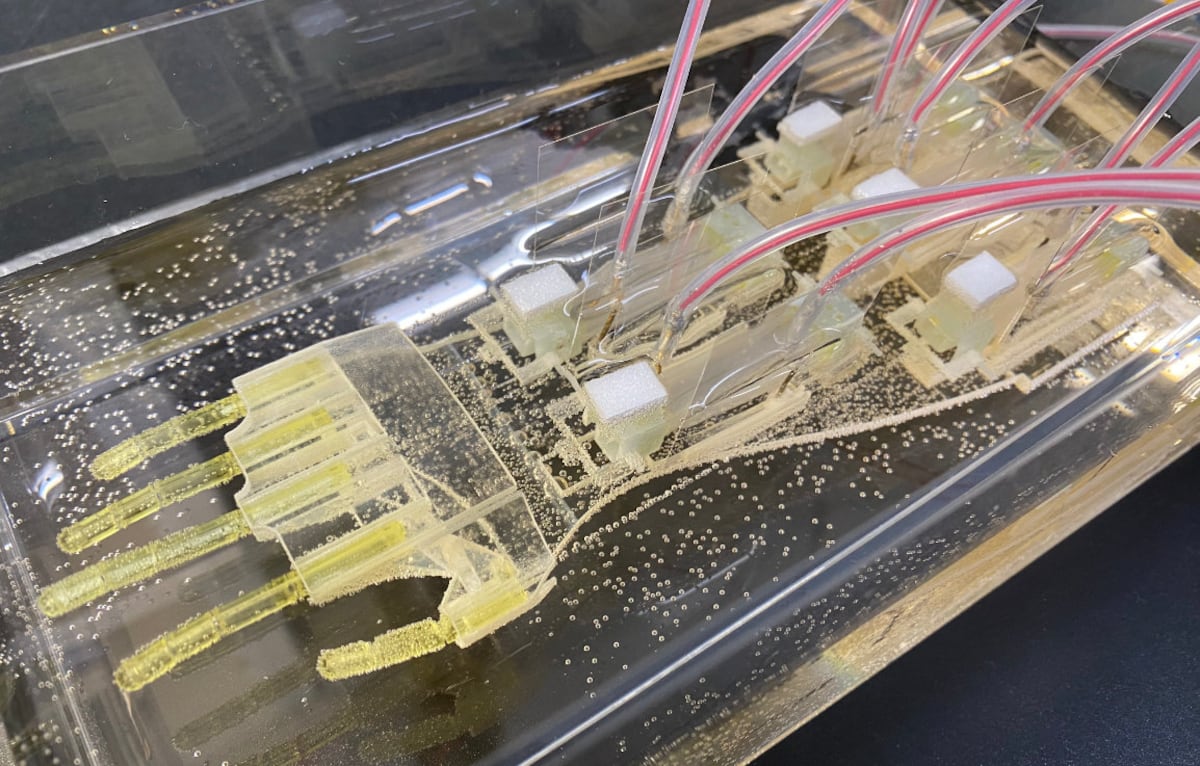
Imagine a prosthetic limb that not only moves like a natural body part but also regenerates and is made from the recipient's own cells. This concept, once considered science fiction, is becoming a reality through cutting-edge bioengineering research. The University of Tokyo, alongside Waseda University, has crafted an 18-centimeter robotic arm from human muscle tissues, capable of finger movements. Meanwhile, in Barcelona, the Institute for Bioengineering of Catalonia (IBEC) is utilizing 3D bioprinters to imitate the internal structure of muscles, matching their natural form and functionality.
Professor Masaharu Takeuchi from the University of Tokyo's Graduate School of Science and Technology states that this technology could revolutionize prosthetics, pharmaceutical testing on muscle tissues, and soft robotics requiring gentle movements. The hand created by Takeuchi's team is the largest of its kind, constructed from thin muscle tissues grown in nutrient-rich solutions, supported by biocompatible polymers and delicate cables.
One major challenge they faced was generating enough muscle force to move the hand. Increasing muscle mass is necessary, but overly thick tissues impede nutrient and oxygen delivery, leading to cell death. The solution involved rolling thin muscle tissues, akin to sushi rolls, into a complex multi-joint structure dubbed MuMuTAs, which were then integrated into a cable-driven robotic frame.
Electrical stimulation keeps the arm active. When electricity is applied, muscles contract, pulling on cables connected to fingers, allowing them to bend, move, and grip objects, mirroring the function of tendons. Such movements weren't possible with previous biohybrid robots, explains the Japanese scientist.
IBEC in Spain is exploring alternatives to external electrical stimulation for biobots. By embedding sensors and electrodes directly into muscle, they've developed more localized and controlled stimulation systems. This approach not only mirrors real muscle function better but also aids in studying muscular responses to drugs and other active agents.
Florencia Lezcano from IBEC highlights their use of 3D bioprinters, which employ bioink—a blend of body-compatible materials and living cells. Initially, they printed simple shapes, evolving to complex muscle structures that replicate the organized internal architectures enabling organ functionality. Lezcano notes their success in orienting fibers to create muscle structures akin to those in human bodies.
The rapid progress excites researchers. They've moved from printing shapes resembling worms to muscles that mimic human models, are functional, and can be locally stimulated. Samuel Sánchez from IBEC dreams of contracting and strengthening muscles using one's own cells.
To realize these dreams, Takeuchi emphasizes the need for controlling muscle tissues via neural signals from the brain or peripheral nerves, and ensuring long-term viability outside lab environments. IBEC focuses on vascularization, the formation of blood vessels in tissues, as a key barrier. Lezcano suggests prevascularized organs could be connected to a recipient's body directly like transplants.
Sánchez identifies two major challenges: designing coatings to replicate hand conditions—maintaining 37-degree temperatures and renewing nutrients—and scalability, creating systems to support natural-sized organs or muscles. Despite challenges, he believes they are on the right track, noting the revolutionary ability to print functional human cells and study their responses.
Beyond the promise of bionic prosthetics, bioengineering could transform medical and pharmacological testing. Instead of animal trials, biologically printed human models could expedite results and enhance test precision. In the U.S., the FDA already permits skipping animal testing in favor of bioprinted tissues for drug evaluations in some cases, though Europe lags behind.
We are looking for an independent senior editor

LEAVE A COMMENT