We are looking for an independent senior editor
Apply Now





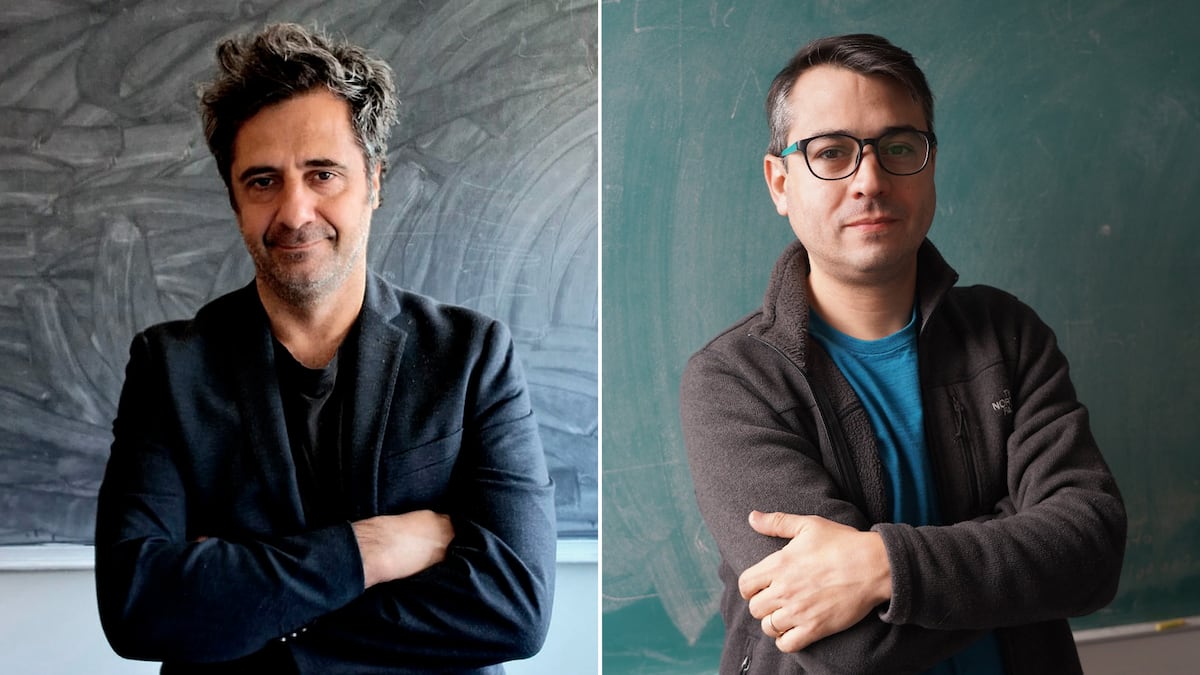
On a summer night, Buenos Aires is devastated by a deadly, toxic snowfall. Streets are lined with the deceased, and survivors are trapped in their homes; electronic devices have failed, plunging the modern world into darkness. This apocalyptic scenario sets the stage for 'El Eternauta', a science fiction series featuring Ricardo Darín, inspired by Héctor Oesterheld's work, first serialized in 1957. Seventy years later, this story of survival, centered on a collective hero and the notion that no one can be saved alone, is updated with a contemporary scientific lens. Behind the scenes, two renowned physicists were enlisted to enhance the story's credibility and theoretical backbone.
While retaining the core plot of the original—a group of friends battling a lethal snowfall and an alien invasion—director Bruno Stagnaro integrates basic science to address today's challenges. Argentine physicists Gastón Giribet and Pablo Mininni, who are passionate about science fiction, provided scientific guidance to the production, focusing on magnetic fields, pole inversion, and the Van Allen belt, themes that gain prominence in the narrative.
As Stagnaro embarked on adapting 'El Eternauta', he sought a plausible dystopian scenario to explain the deadly snowfall without relying on the 1950s cultural and scientific imagination, which often revolved around nuclear energy dangers or atomic bombs, as depicted in the original comic. This led him to explore contemporary fears and threats, delving into books about solar storms, magnetic field inversions, and electromagnetic pulses. He also gathered data on solar flares, supernovas, and the Van Allen belt to ascertain which might instantaneously isolate the country.
“It was essential to preserve the deadly snowfall, but its origins needed to reflect today's imagination,” Giribet muses. Specializing in quantum, string, and relativity theories, Giribet began collaborating with the film director in 2018, well before production commenced. “We evaluated his ideas and supported him in crafting various scenarios,” Giribet shares over the phone from New York University.
The goal was to ground the narrative scientifically, especially the unexpected deadly snowfall that surprises Juan Salvo (Darín) and his friends during a card game. “A literal translation of the story was ineffective because it was deeply intertwined with late 1950s imaginations, the fears of that era, and the emergence of nuclear energy. Today, these fears are more linked to climate change, natural catastrophes, or asteroids,” Giribet points out.
Moreover, “it had to be functional for the story,” the physicist adds. In one episode, the character Tano Favalli (César Troncoso), an electrical engineer with a penchant for physics—originally a physicist in the comic—speculates that the snowfall's origin is a reversal of Earth's magnetic poles.
Stagnaro would arrive at meetings equipped with information and readings, presenting ideas, listening intently, and later posing precise, probing questions. “He inquired about the characteristic times of pole migration and radioactive particles. He approached with ideas and asked if they were plausible,” Giribet recalls. One day, Stagnaro called to ask which classic yet relevant book on electromagnetism a character might be reading. “He was meticulous, obsessive, and quickly grasped my explanations,” Giribet affirms.
Unlike Giribet, researcher Pablo Mininni harbors a passion for science fiction; as a youth, he was inspired by Isaac Asimov, Ray Bradbury's books, and films like 'Interstellar' and 'Star Wars', which influenced his scientific pursuits. Thus, he was thrilled to welcome Stagnaro to his University of Buenos Aires office. “He arrived curious about ensuring that basic science in science fiction was believable and accurate,” Mininni recalls, five years after their initial meetings.
With the premise that the deadly snowfall must be linked to a natural phenomenon involving the magnetic field, Mininni utilized his expertise in solar physics and Earth's magnetism to aid 'El Eternauta'. “We discussed Earth's magnetic field, charged particles in solar wind, particles from the sun generating auroras seen in the series,” Mininni describes during a break at the university's Faculty of Exact Sciences.
During their meetings, they developed hypotheses about a potential massive blackout leaving only old devices operational. “Old technology works,” Favalli asserts in one episode. “Scientifically, an electromagnetic pulse was most believable,” Mininni claims.
For the geophysics and atmospheric sciences expert, a real-world blackout of electronics or Earth's magnetic field is conceivable, albeit due to various causes and scales. “There are military ways to destroy electronics. That's an electromagnetic pulse used for non-peaceful purposes,” Mininni explains.
The magnetic field shields the planet from solar wind, particles sent by the Sun into space. Upon contacting the magnetic field, they are directed to the poles, accumulating into auroras borealis. (Spoiler: this is how the series begins). This shield prevents solar particles from obliterating the ozone layer and directly impacting living beings.
In the fiction, Favalli discovers his compass has stopped working and correlates the lethal snow to the Van Allen belts—the radiation belts encircling our planet—which he describes as “a shield protecting Earth from solar winds.” “If the poles vanish, radioactive particles rain down,” he suggests.
Collective Hero, Collective Science
Oesterheld—disappeared by the Argentine dictatorship along with his daughters and sons-in-law in 1978—was a man of science: before becoming a writer who transcended generations, he pursued a doctorate in natural sciences and worked as a geologist for the oil company YPF, as chronicled by Diego Fracchia in his book 'In Search of the Forgotten Geologist'.
Mininni values being invited to contribute to the production. “Science must be credible from the outset; science fiction audiences expect certain codes. But I also reflect on science's role in society. We face problems not solvable individually, like climate change or artificial intelligence challenges. Decisions are collective. A scientist advises but cannot be an external entity to society; in modern society, decisions are made collectively,” he concludes.
We are looking for an independent senior editor

LEAVE A COMMENT